
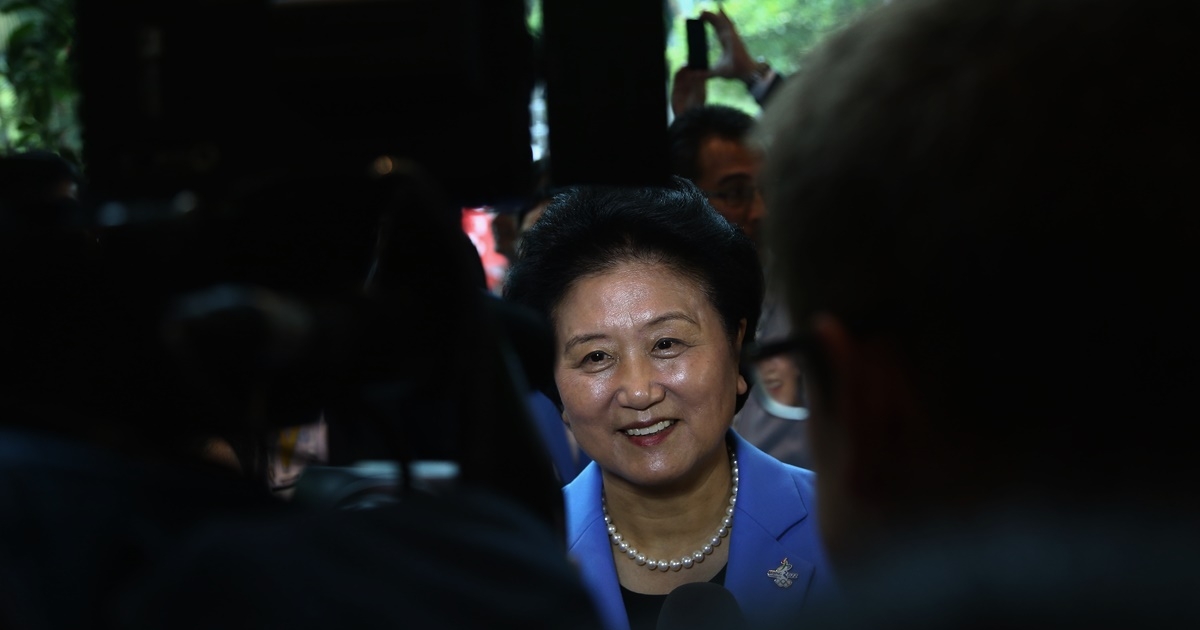
Liu Yandong, who served as China's vice premier from 2013 to 2018, died in Beijing on October 28, 2026, at the age of 81, leaving behind a legacy of shaping national policies across education, science, and culture.
As a senior leader in the Communist Party, Liu Yandong played a crucial role in promoting educational exchanges and technological cooperation with the United States and European nations. Her death marks the passing of a generation of leaders who navigated China's reform era.
Liu Yandong's career spanned over 4 decades, during which she held various leadership positions, including vice premier, vice president of the organizing committee for the 2008 Beijing Olympic Games, and director of the United Front Work Department. She was a member of the 17th and 18th Central Politburo, and served as vice chairman of the Chinese People's Political Consultative Conference for 1 term. Liu was 81 years old when she passed away, leaving behind a legacy of dedication to the Communist Party and the Chinese government.
Political Career
As vice premier, Liu oversaw complex portfolios, including health, sports, and science, and managed preparations for the 2008 Beijing Olympic Games. She also directed bilateral dialogues with the United States and European nations, focusing on educational exchanges and technological cooperation. Liu's tenure saw significant developments in China's education and science sectors, with investments totaling over 100 billion yuan in 2015 alone. During her time in office, China's GDP grew from 21.4 trillion yuan in 2007 to 54.3 trillion yuan in 2016, with an average annual growth rate of 7.8%.
Before entering the State Council, Liu directed the United Front Work Department for 4 years, mobilizing non-party elites and overseas communities. She held concurrent leadership posts within the Chinese People's Political Consultative Conference, serving alongside other prominent leaders, including Xi Jinping, Li Keqiang, and Zhang Gaoli. Liu's career was marked by her commitment to promoting China's interests abroad, with over 20 official visits to countries, including the United States, Germany, and Australia, between 2013 and 2018.
Legacy and Transition
Liu Yandong's departure marks the fading of a specific generation of leaders who navigated China's reform era. Analysts assess her impact on gender representation within the 25-member Politburo, where female officials remain rare, making up only 2.4% of the total membership. Funeral arrangements are expected to be organized by the central committee in Beijing, with official tributes scheduled for the coming week. State institutions plan memorial ceremonies to honor her decades of administrative service to the party and government apparatus, recognizing her contributions to China's development, including the establishment of over 10 major scientific research centers and the promotion of educational exchanges with over 50 countries.
Liu Yandong's legacy will be remembered as a testament to her dedication to China's growth and development, with her impact felt across various sectors, from education to science and technology, and her influence extending beyond China's borders, with a lasting impact on the country's relations with the United States, Europe, and other nations.